In A Rut [Classic]

It happens every time…

I’m so frustrated.

Every so often, but not as often as I would like, I get the urge to write. I think of a good idea or two and sit down in front of the typewriter hoping to develop one of them to the point of a story. But every time, all I do is sit looking at the keys.

Well, I do get some typing in — because I usually end up with two or three false starts which I save just in case I think of something to add to them later.

Maybe I should string them all together into one piece and call it “Images” or another equally silly name. Or better yet, maybe I should write something about how I can’t write anything.

Let me think… I got it:

“It happens every time…”

I Was Once An Ant [Classic] (13 line poem)

Surprisingly, I found an old poem that isn’t about monsters and death.


I was once an ant.
Timid. Afraid.
Blindly rushing about with no purpose.

Then it happened.

I was once a stone.
Ignorant of my surroundings.
Achieving nothing.

Now…

Now I soar with the wind,
——and look down on the stars.
Now I stride across oceans,
——and mountains stand aside.

I am in love.

Chicken Every Sunday [New] (36 line poem)

Larry’s secret autobiography

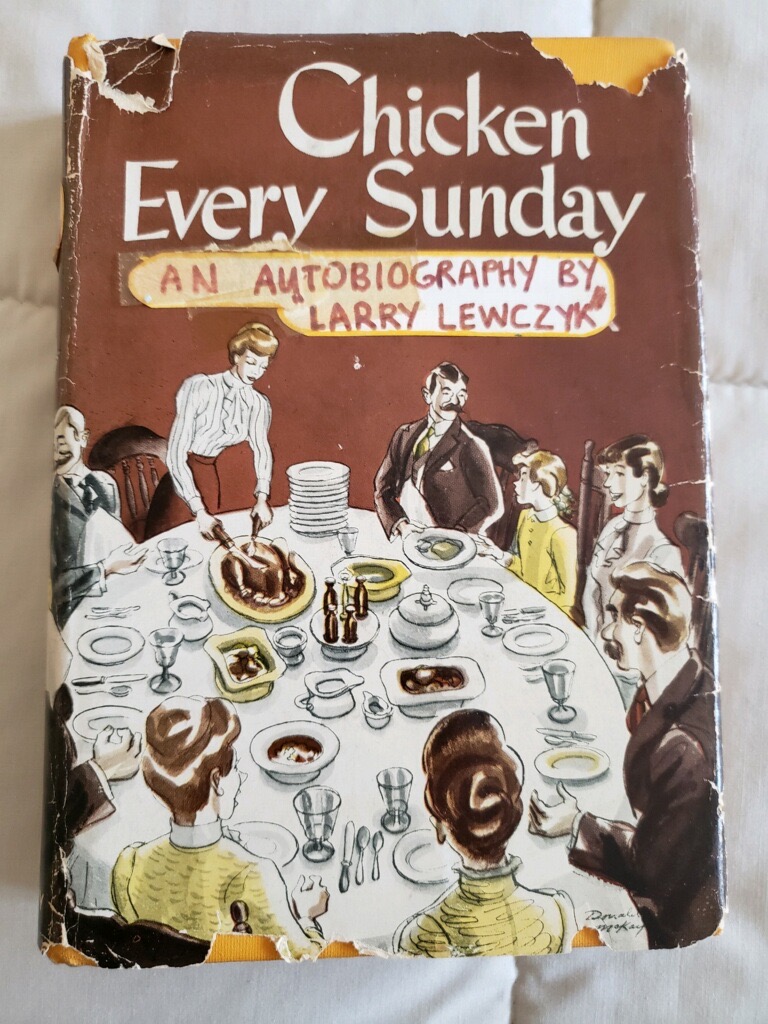
So, to explain – there has been an ongoing joke among my siblings that my brother Larry wrote an ‘autobiography’ about my mom serving chicken every Sunday (which she did). Weirdly, there is an actual book titled ‘Chicken Every Sunday’ where one of my siblings subbed in Larry’s name.

We talked about it on a video call, so I felt compelled to write ‘the story’, but ended up with this poem – which I shared with my siblings. Each verse captures something from our childhood lives in West Virginia


May we have some frozen carrots?
May we have some frozen peas?
May we have some
chicken chicken
every every
Sunday, please?

Running barefoot down the alley,
Dust and oil up to our knees.
May we have some
chicken chicken
every every
Sunday, please?

Paint the house pink every summer.
Paint the bottoms of the trees.
May we have some
chicken chicken
every every
Sunday, please?

Bluegill fishing at Westvaco —
Catch one? There’re no guarantees.
May we have some
chicken chicken
every every
Sunday, please?

Find a horse and bring it back home
In the 1970s.
May we have some
chicken chicken
every every
Sunday, please?

Garage sleeping — we all did it.
Breezeway always brought the breeze.
May we have some
chicken chicken
every every
Sunday, please?

Sabotage [Classic] (1200 word story)

From my youth. I’m convinced one of my siblings ‘wrapped up’ this story for me. There is some handwriting that isn’t mine — plus an abrupt, typed, silly ending. I’ve therefore titled this post ‘Sabotage’.


The four young brothers stared solemnly at each other across the heavy oaken table. They were two sets of twins, born less than a year apart. Meredith was the oldest of the four, older than his twin Evan by a few minutes. This appeared to be the case for Meredith was the only one of the four to have a beard, made even more striking by its coloring, the blackest of blacks. This beard in no way made him appear sinister — for the innocent blue of his eyes and the light color of his skin made him seem an angel or a shepherd boy — in spite of his serious mouth. Evan had curly red hair, far-set green eyes, and a laughing face. He was the largest of the four as was Meredith the smallest. The younger set of twins, Lionel and Randal, looked very much the same with their solid build, sandy-blond hair, and deep brown eyes. It was not uncommon for even old acquaintances to confuse the identities of the two. The younger twins were thought of more as “The Twins” than their older brothers who, though bearing a notable family resemblance, seemed to look nothing alike when compared to their brothers’ similarity.

All four brothers appeared younger than their years, though all were remarkably athletic; each far outshining his peers in swordsmanship and horsemanship. There seemed no end to their ability to master the skills of war as well as the incredible feats of acrobatics displayed by the traveling troops that visit the kingdom every few years.

They were handsome young men and seemed to be the sons of some god. They did, in fact, have noble blood — for their father was the beloved brother of the king, and their mother possibly the most beautiful woman in the whole kingdom which, in itself, covered hundreds of square miles. They had grown to manhood in the royal castle — a sprawling building of white marble — and it was in an upper room in the castle that they discussed the recent disappearance of their beautiful mother.

“Now, who was the last to see her?” Meredith, taking natural charge.

“A kitchen girl saw her walking in the garden shortly after midday, and no one remembers seeing her after that.” This was Randal disclosing the findings of their afternoon search. “It would seem that she must have wandered off into the forest.”

“Then what are we doing here?” demanded Evan, already rising from his chair — willing to search the forest on his own.

“Calm down,” ordered Meredith, “Evan, always acting without thinking. That will get you into trouble someday.” This remark brought smiles from the twins and a mild look of warning from Evan as he reseated himself.

“We have to plan our course of action,” continued Meredith. “It would be dark by the time we got a search party organized — and besides, she may yet be in the castle even though our search showed nothing. She has enough sense to return to the castle at dusk.”

“Unless she’s hurt,” commented Randal. 

“Or abducted,” added Lionel, the more fanciful of the two.

“She may have grown tired and fallen asleep in one of the unoccupied lower sleeping chambers,” remarked Evan.

“Well, we’ll soon know — because the king should have completed a more thorough search of the castle any moment now,” stated Merdith.

Just then, a messenger burst into the room, in his haste forgetting to knock. “Your mother is not in the castle. The king is organizing a search party now, and he wishes…” The messenger was nearly knocked over as the four brothers rushed from the room.


They were met by their father and the king in the hall outside the council chamber. Both looked glum. It was the king who was first to speak.

“I want to tell you boys that this search is merely perfunctory. One of the gardeners saw your mother carried and taken off by a dragon and taken east.”

“Desmond!” exclaimed the twins in unison, naming the evil wizard whose castle was in the thickest part of the Eastern Forest.

“Exactly,” agreed the king, “the search of the nearby forest is only a precaution — but we have no better explanation for your mother’s disappearance.”

“You are old enough to decide for yourselves what you want to do.” their father told them.

Evan turned to the twins, “See to getting our horses saddled and provisioned. We’ll need…”

“It’s already been taken care of,” their father told them with a smile, “you may leave at once.”

After short thank-you’s and good-bye’s, the boys raced toward the stables.


After a full day of hard riding, the brothers found themselves at Desmond’s black castle at nightfall. They left the horses to forage for grass among the thorny underbrush, and abandoned the cover of the forest to approach the castle. The castle was tall and black, overgrown with ivy, and surrounded by a broad, murky moat in which occasional dark forms could be glimpsed. There was no drawbridge, nor any openings in the castle walls for twenty- five feet above the ground.

“First obstacle, the moat.” said Meredith as he tossed a stick out into the moat. As soon as the stick hit the water, there was a frenzied turmoil that increased until suddenly the commotion stopped and the stick was nowhere to be seen.

“Wow.” said Evan.

“Maybe we could fell a tree to act as a bridge.” again Evan.

Meredith replied, “It would take a day to cut down a tree large enough to span the moat — even if we had the proper tools.”

“We could jump.” commented Lionel, “Around the back of the castle to the left the moat’s not more than fifteen feet wide. We’ve all jumped more than that in practice.”

“We’ll just fling our swords across first to make it easier.” urged Randal.

Meredith considered, “It seems that we don’t have much choice.” So they started toward the left side of the castle.


After they had reached the narrow part of the moat, Meredith had them line up single file about ten feet from the launching point.

“We will all jump at the same time so if one falls in mid-air, we can catch him.”

All four brothers ran to the edge but, at the last moment, Meredith — who had been the last in line — tripped, toppling all four into the moat. There was a great disturbance in the water until all was finally still.

The last thing heard was the word “wow” as four heavenly bodies ascended to the sky.


The king, and his brother — who was the four brothers’ father, and the four brothers’ mother’s husband — committed harakiri and died.


Deep in the heart of the castle, the mother of the four brothers screamed and kicked as the evil dragon breathed hot breath on her. His looming face came closer and again she screamed.

“AAAAAAAAAAAAHHHHHHHHH!!!!!!!!” she said as the huge lizard made her hair catch on fire.

Just then the evil Desmond entered the room and called the dragon away from her. He approached the woman and proceeded to slit open her throat with his long sharp fingernail. The blood gushed in slow motion, “PSSSSSSSSSSSSSHHHHHHHH”.

“That will teach your meddling youngans,” he mumbled as he walked away to end the story.

Brain M [Classic] (400 word story)

Another very silly story (hopefully) written when I was quite young — probably around the same time as this other silly one.


The alien glanced about hastily. He couldn’t help feeling a little paranoid. After all, this was the first contact with this race and, as with all dealings with unknown races, no weaponry was permitted.

He had arrived shortly before sunrise, alone in a shuttlecraft that he had hidden in the treacherous crags of some mountains a few miles to the west. He then began hiking his way toward this settlement — which was in the foothills of another nearby range of mountains. About three miles from the village, he had been spotted by a band of hunters from the village — who had immediately lost interest in the hunt, and had gathered around him and examined him with curiosity. He was somewhat relieved at having been discovered — because, unarmed, he had little doubt that some of the local fauna could make short work of him.

He had a small knowledge of the local language, and got the idea from their conversation among themselves that they were taking him to someone named ‘Brain M’ — obviously some local intellect or philosopher who acted as a lawmaker. They had neglected to speak to him — possibly thinking that he could not understand. He then decided to keep quiet, and keep whatever advantage this secret knowledge would give him — however slight.

He had been taught to accept any strange appearance that another race may present, yet he found these beings somewhat repulsive, nonetheless — and they, undoubtedly, found him so also.

So he had been politely escorted to the village, and now found himself outside the abode of this ‘Brain M’. The men escorted him in, and he was mildly surprised to discover that this Brain M was a butcher — who was in the middle of cleaning and cutting up some small animal, and did not look up until he was done. It did make some sense that this person was a butcher — because it was entirely common for a leader to be some man of everyday importance in cultures of this technology.

Brain M walked toward the alien, absently carrying the heavy implement he had been using on the animal. They smiled at each other, and the alien’s guards stepped back — allowing room for the anticipated meeting. Time froze for an instant, as the first momentous meeting of the two races took place.

The men cried in unison, “Brain Em!” and the butcher’s tool came crashing down.

Then blackness.

Paper! Paper!

A couple of interesting notes around the paper that my old writings are on:

  • First, most of the paper we used as kids was the backside of old office paper from my dad’s work. So the backside of many of MY writings are FMC logs of chemical shipments, etc.
  • Another interesting thing is — now that I’m using google to convert my old writings to digital text, I’ve found that some paper (not the kind mentioned above) is thin enough that the page image shows the text from the page beneath — which I then need to edit out (a bit of a bother). In other words, scanned text shows future paragraphs. I might need to start inserting a blank paper between scanned pages to avoid this bleed through.
  • (Also, I’ve previously mentioned how some of my stories are on tractor feed paper…)


Revenge [Classic] (unfinished story)

4000 words! And unfinished…


The judge glared down at me, wiping my saliva from his face with a bright yellow handkerchief. He was scarlet with anger, tendons bulging outrageously from the sides of his neck. The crowd behind me sat in stunned silence.

The courtroom was filled to overflowing, men and women were packed into the back, the rear doors, and out into the street. Children were perched on shoulders, relaying what was happening to their parents. The tall, narrow windows of the courtroom — which seemed to capture and intensify the midday heat — caused me to wonder if this building were not used incongruously as a church on Sundays.

I stood before the judge, my hands bound behind me as the two men with guns who flanked me shifted nervously on their feet. A droplet of sweat made its way lazily down my cheek as I watched him in unconcealed amusement.

The silence was broken by a girl’s giggle from the back of the room.

The judge came to life. “Take him away!” he shrieked, his own spittle spraying. The entire courtroom exploded into sound, everyone trying to be heard above his neighbor. I was surprised that the judge had controlled his temper for this long, since my courtroom demeanor includes far more than spitting in the judge’s face as he passes sentence. The vocabulary I had used today would have burned even my father’s ears, master curser though he was.

I struggled as the men beside me grabbed me by my upper arms and dragged me toward the rear, pushing their way firmly through the crowd. I found time to wink at the girl who had giggled. She was no more than seven or eight, and was dressed in a spotless white dress. She smiled back, but I was hauled quickly away and out of the noise and stifling heat into the bright noon sunshine.

Either it was normal procedure to hang people immediately after sentencing, or they made an exception in my case, because they dragged me along the main street toward the gallows that was located at the edge of town. On either side of the wide street were closely-spaced wooden buildings which grew scarcer nearer to the gallows. My efforts to free myself kicked up thick clouds of dust from the street which looked as if it had not seen rain in months. The gallows, now distantly visible at the end of the street, drew ominously nearer. Word of the inside festivities had spread swiftly, because the street was now lined with people in twos and threes hurrying to ensure a good view.

After what seemed like years, I was supported, shaking from exhaustion, at the foot of the gallows. An air of expectancy hung over the crowd which was nearly three times as large as the one in the courtroom — and was probably composed of every man, woman and child in the town. I was somewhat surprised at the presence of the children, but I guessed that perhaps the parents were trying to show them why they should be good and not break the law. I wondered how many hangings this crowd had witnessed, how often a body could be seen silhouetted against the evening sun as a silent reminder of their self-appointed superiority.

The stairs leading up to the platform were wide enough for three to walk abreast, which is how we ascended, the sun beating relentlessly upon my head. The wooden stairs creaked under our weight, but showed no signs of collapsing. I struggled as we climbed, trying to buy time.

We finally reached the top, and I was herded toward a four-by-four foot trap door with a lever upright next to it and the noose hanging long enough to be resting on the platform. One of the men produced a hood from somewhere, and raised it toward my head. I told him that I did not want it. “It ain’t for you,” he said, “It’s for them.”. He motioned with his head toward the crowd, “Hanged men aren’t too pretty.”

“I still don’t want it,” I repeated, “don’t I even get this last request?” He looked at me, shrugged, and tossed it aside. I breathed a shaky sigh of relief. That had been close. I needed to be able to speak clearly, and that isn’t too easy inside a hood.

They positioned me above the trap door, whose unsteadiness caused me to wonder whether or not it would give way prematurely. When the noose was placed upon me, the slack hung down to my knees. They pulled the knot tight and positioned it on the left side of my neck. Then they waited.

I looked out over the crowd, noticing that they were eager to watch, but careful to avoid meeting my gaze. I caught sight of the judge excusing himself through the crowd. He separated himself from the others and strode solemnly forward to read the charges and formally condemn me to death.

“Amos Jackson,” he intoned, which wasn’t my real name — though my fathers’ name was Jack. “You have been duly tried and found guilty of the murder of Cyral Blackwood.” Not his real name either. He went on to speak of my “lack of Christian morals” and “intolerable criminal character” — finally ending with, “And may Almighty God have mercy on your soul.” He paused for a moment with bowed head, and then looked up and nodded to the man on my left.

I glanced up at the sun. It shouldn’t be more than a few minutes. I had to stall.

I looked to my left where the man was reaching toward the lever. He stopped when I yelled unoriginally, “Wait!” I took a breath and couldn’t help but smile as I felt the power flow into me. I thought carefully back to what I was supposed to say. The crowd was intensely still as I opened my mouth to speak.


It was a pity that my execution would not be in the same world as my birth. I would have liked to have had my family and friends, and even poor Greshem, witness my escape. They would appreciate a show of power more than these people who lived in a world where magic was nearly forgotten. Maybe next time.

I was born Amonsl, second son of Jack the Cooper of Smithton. Smithton, located where the Brine and Capering rivers join to form the Leewater, is also one of the closest approaches to boatable water that Blackwood Forest makes. These two factors make Smithton the leading center of trade for the region, which in turn made my father, the leading cooper, a very prominent man.

Up until the time I was twelve, I was content with the idea of following in my father’s footsteps. The understanding was that when my father died, my brother Mordel, who is ten years my senior, and I would take over the coopery. Like my brother, I had nearly grown up in my father’s shop, the workmen and I becoming good friends, while I learned the trade at an early age. The noise and bustle of the shop kept me dazzled for many years. As I grew older and my interests broadened, I was intrigued by the fact that visiting merchants and tradesmen always seemed to bring their eligible young daughters along with them when discussing business with my father. They were apparently trying to insure good, inexpensive relations with my father by marrying into his family. Approaching my teens, it was not unreasonable to be thinking of marriage. My father had married at fourteen, my brother at sixteen. My brother’s son Will was only eight years younger than I.

Life went without incident until one day an eastern magician came to Smithton to perform. My father received a written invitation offering free admission for him and his family (an odd courtesy to extend to the rich). The name of the magician, it said, was Greshem of the Eastern Hills. He would perform an hour after sunset. Attending with my family, I didn’t know what to expect and did not imagine that it could change my life so drastically.

Word spread rapidly, and the crowd began to gather shortly after sundown. By showtime, most of the town were waiting eagerly for the magician to make his appearance. Suddenly, he was there, dressed in red and silver, emerging from a cloud of smoke. He seemed to me to be the oldest living human I ever seen, but his voice was young and strong. His eyes blazed like embers, and seemed to single me out, to burn into my soul. Throughout the entire act, I felt that I was the only one in the audience, that he and I were the only things in the universe. The splendor of the show was indescribable, though I now realize that it was composed of simple parlor tricks that require very little magic, if any at all. Nonetheless, the crowd went home feeling that they had gotten their money’s worth.

I stayed after everyone had gone, wanting to speak to him — to tell him how much I wanted to be a magician also; but I hid in the shadows, too afraid to find the words. I watched him for a time, packing up his equipment — until he turned to me and said, “Come over here, boy,” as if he had known I had been there all the time. Stepping out into the light, I walked warily over to where he had sat down.

“What do you want?” he asked, his voice much older than it had been during his act, his eyes no longer blazing. How could he not know?

“Sir,” I had said, “can anyone learn to be a magician?” He studied me carefully for a very long time. I thought uncomfortably that he wasn’t going to answer, but at last he spoke.

“No, not anyone. A student of the arts should be young, bright and willing to devote himself entirely to learning.” I was silent for a time, summoning up courage for my next question.

My heart sank as he stood and began to walk away, carrying his few belongings. I felt like crying, but was too stunned to do anything. When he was nearly gone from sight, he turned to face me. Again, we were the only two things in the universe, and I heard him as clearly as if he were standing beside me. “Be ready with a horse and two days of provisions at sunrise.” Then he was gone, and I was left overflowing with emotion. I was halfway home before I realized that I had never actually asked if I could come.

I couldn’t sleep that night, and was in the stables an hour before dawn making preparations. Leaving word with my mother, as I was unable to face my father, I was hurrying toward the east end of town as the sky began to brighten. Greshem did not acknowledge me as I caught up to him, but I rode proudly in his wake as we journeyed to meet the rising sun.

It was three years before I returned to Smithton. I found that during that time both of my parents had died of a devastating plague during one of the rainy seasons. My brother Mordel, who had kept the business running successfully, was not especially happy to see me — for fear that I would claim my half. He was saving it for his son Kellen (Will had also died in the plague). I stayed for only one night, and then went back to my home in the Eastern Hills.


“It is essential for a magician to be able to see through illusions.” Greshem stood before me in red and silver. I had been apprenticed to him for eight years — most of which were spent in the small cave in which we now were. The cave was located high in the Eastern Hills, ten miles from the nearest town, and nearly thirty leagues from Smithton. I had learned much during that time. Delving deep into obscure disciplines and the archaic branches of learning, I had come slowly to understand the lore of the magician, I had also grown slowly to despise Greshem — because of the humor he found in my mistakes, and the joy he took in humiliating me.

Ten feet away, Greshem unconsciously smirked, anticipating my failure. His tone, that of a lecturer, was in odd contrast to the dagger he held loosely in his right hand. My eyes were on the dagger. “Illusions affect sight, hearing, and smell. The important difference is that illusions do not have the aura of the objects they appear to be, a difference you should be able to detect by now.”

Actually, I wasn’t as good at auras as I should have been — and the pressure of one of Greshem’s tests would only make things more difficult. The idea was simple though — a dog made to look like a cat still has the aura of a dog — a difference that a trained magician should be able to recognize at a glance. I chewed my lower lip and watched his right hand.

“An illusion can totally lack reality,” a flower appeared then disappeared in his previously empty left hand, “or it can be an alteration of reality,” the dagger in his right hand became a snake, “but one cannot hide reality behind nothing,” the dagger vanished for a moment, but even I could still see its aura.

Suddenly, his shoulders tensed and he threw the dagger, or did he? Time seemed to slow as I concentrated on the weapon e flying toward me. Did it have an aura? I couldn’t tell, and decided to play it safe. I dodged, and the dagger disappeared several feet in front of me leaving no aura. Illusion.

He was smiling openly as he threw the next dagger. I watched it hurl toward me. Illusion, I decided. Even if it weren’t, it would only nick my left arm. Standing still, I met his amused gaze — and the dagger painlessly creased my left shoulder drawing bright blood. Damn.

He laughed, “Not guessing very well are you?” he taunted. With a gesture, my wound vanished. It had been another illusion, damn him!

He threw another dagger and turned his back. Dodging, I heard it crash into the wall behind me. Inconclusive either way. Years of persecution stoked my anger. Drawing my own dagger, I raced toward him and dove at his back. I passed through him and hit the ground hard at the entranceway, my dagger clattering harmlessly out into the night. His laughter boomed loud from the shadows at the side of the cave — where my subconscious told me he had been the whole time. I glared at him, still not totally sure if he were real or another illusion. Getting to my feet, I ran shamefacedly out into the darkness.

I rushed aimlessly away from the cave. My eyes were filled with the red haze of anger. After perhaps fifteen minutes, I found myself beside a jagged outcropping of rock overlooking the eastern desert. I was at one of the highest points in the mountains. I marvelled silently at the good fortune I had had in not falling to my death along the way. Travel in the mountains is dangerous enough in full daylight, but to charge about recklessly at night is folly. I looked out over the desert as my breathing slowed. The moon was beginning to rise to the southeast. Long, silvery fingers of moonlight stretched bleakly across the desert floor casting dark silhouettes of the scattered rock formations. I watched the shadows shrink to half their size, but still my anger did not lessen. I would kill Greshem if I could, but should I try and fail…

I heard some rocks scatter behind me as someone approached. Greshem? Seeking to make amends? I was thinking of ignoring him until I remembered my attempt on his life. Fearing reciprocation, I spun around. Before me was a tall, bearded man much younger in appearance than Greshem. He was dressed in blue with a red cross upon his left shoulder. His staff glowed dimly. I checked automatically that it was not another of Greshem’s illusions.

“Cephus!” I hissed. This man was a rival magician as great as Greshem — but, if tales can be believed, far more evil. Greshem was often complaining of Cephus interfering in his plans. I made preparations to defend myself.

“Come now, lad,” he said smiling broadly, “I come in peace!”

“Why should I believe you, dog? Your very breath reeks of lies!”

‘You believe me evil?” he laughed good naturedly, “Where I come from, tales of Greshem’s atrocities are terrible enough to curdle blood. He looked at me penetratingly. “Don’t believe everything you hear.

I relaxed somewhat. “What do you want?”


I stood at the cave mouth, staring at Greshem’s back as he sat cross-legged before the fire. I thought back to my encounter with Cephus. He had stated that he had a plan where I could humiliate Greshem without fear of retaliation. As I asked him to explain, I already knew that I would accept. My eyes narrowed as I recalled the many times I had been humiliated and disgraced by Greshem. Savoring my hatred, I thought about the fact that soon I would no longer be his apprentice. This act would be a fitting farewell gift.

Greshem misinterpreted my pause in entering. “All is well,” he said, “I forgive you for your rashness.”. Biting back a sarcastic reply, I entered the cave and found my bedroll. Lying down, I closed my eyes — but was too anxious to sleep. The waiting seemed endless. Unbelievably, I must have dozed off for a time because the fire suddenly seemed much lower than it had. Greshem finally retired when the fire did, but I lay still another hour before rising and creeping carefully toward him.


As a magician increases in knowledge and power, he discovers after a time that there is a limit to the amount that he can accumulate. To increase further, the magician must employ some outside means to relieve the burden of further gains. The typical solution is to store portions of previously-obtained wisdom in some personal magical item called a ‘token’.

Once a magician acquires a token, he is said to be at the ‘master level.’ Many masters store the bulk of their knowledge in their tokens. This being the case, tokens are carefully guarded and protected. Since it is possible to become attuned to another magician’s token, it sometimes occurs that a younger magician gains the powers of a much more experienced magician, thus saving many years of studying and training.

Standing beside the fire I had just made, I turned Greshem’s token over in my hand. It was a small crystal, the size of my smallest finger, fastened to a gold chain. It flashed  brilliant yellow in the firelight.

Cephus had given me a tiny mushroom that he had picked up in his travels — whose spores, when inhaled, render the victim unable to perform any magic for twenty-four hours. The mushroom must be crushed beneath the very nose of the victim. As Greshem’s apprentice, I was the only one whom he trusted enough not to set automatic magical guards against. Therefore, I was the only one who could get close enough to him — even in his sleep.

I had asked Cephus what he would gain if I agreed to his plan. He replied, “The satisfaction of Greshem being defeated by a lesser magician, and also the respite gained by preventing him from meddling in my own affairs for a time.” Spurred on by thoughts of revenge against Greshem, I probed no further.

I looked down at Greshem as he sat against the wall, powerless, his hands and feet bound. Turning to go, I knew that he would be able to free himself once what powers he had left returned. “Worthless lout!” he cried after me, “ungrateful goat! I curse you a thousand times! I shall revenge you into my grave!”

Laughing, I strode from the cave, putting his token safely within my pouch.


Midday found me approaching the woodcutter’s shack Cephus had described. He had instructed me to bring him the token so he could show me how to attune myself to it. Reining in my horse, I dismounted. Cephus met me at the door! “Where is it?” he asked, his eyes bright.

I put my hand to my pouch. “Not so fast,” I said confidently, stepping past him into the building. The world went painfully dark.

I awoke only a short time later, judging by the sun. My brain throbbed in agony, and I had a large knot on the back of my head. My pouch was gone.

I made to cast a spell that would tell me Cephus’ whereabouts, and was perplexed when nothing happened. Going through the motions again with the same result, I came to the conclusion that he must have used one of his mushrooms on me while I was unconscious. All my magic was gone.

I cursed my stupidity. Cephus was by now the most powerful magician in centuries — having certainly taken time to attune himself to Greshem’s token, and I was powerless. Locating my horse, I mounted. There really was little doubt to where Cephus had gone. I hurried back the way I had come to avenge Greshem’s certain death.


Night had fallen before I drew near the cave that had been my home for many years. From many miles away, I could see and hear the battle raging like some multihued thunderstorm, but now, all was eerily silent. It was almost exactly one day since I had robbed Greshem of his powers. If his defenses could hold for a few more minutes…

Suddenly, I was standing beside him, amid a landscape charred and blackened. Though his lifeblood spilled from several mortal wounds, his eyes blazed with a cold fire. He had regained his power. I marvelled at how Greshem could have survived for so long. How little I knew of his power. It was then that I knew fear — for I realized that he could kill me now should he wish.

As if sensing my fear, he smiled weakly. “I have one more task for you Amonsl.” For the better part of a minute, rugged coughing shook his body. A thin trickle of blood oozed from the corner of his mouth as he fought to hang on to his rapidly-fading life for a few more moments. At last, he was once more able to speak. “Destroy Cephus. Follow him to wherever he may lead, but destroy him. Give me your word that you will do this thing.” Afraid to do anything else, I gave him my word.

Breath rattled in his chest as he hurried to finish what he had to say. “Cephus will travel through time and space trying to escape. Do not lose him. Once he is no more, you will wish to return to this plane — but you lack the necessary lore. Merely say these words,” he whispered a phrase in the Old Tongue, “but only after you have slain him! Thus shall I have my revenge.”

He was gone then, upon his face a peaceful, if crooked, smile.

I looked up and saw Cephus standing on a nearby ridge. He sneered at me, then turned and walked away, his laughter louder than the thunder. I sighed and trekked reluctantly after him.


I know where this is going can you guess? Maybe I’ve written the ending already, but it’s not stapled to the rest of the story.

So I’ve gone through all my papers, and I do not have an existing written ending but here’s what will happen: the main character (Amonsl) will pursue and eventually kill Cephus, then say the words that Greshem told him but… those words won’t transport Amonsl back, they will instead kill him (‘thus shall I have my revenge’).
Buzz [Classic] (unfinished story)

I have no idea where this was going. It does seem that I was bored in math class, though…


I had come here looking for Death; now Death has found me. The burden of knowledge is too heavy, and the thought of continued existence too unbearable to turn back now. I have made my decision, and I open the door...


It all began back in math class when I was minding my business, lost in thought at the back of the room. I was quietly listening to the professor drone on — allowing my gaze to drift around the room with a complete lack of conscious interest.

A few students were actually taking notes, but most were patiently waiting for the bell, with the ability to sit and do absolutely nothing but breathe — that most students develop over the years.

One fellow to my right was reading the newspaper, and the two red hot lovers a few seats down from me in the corner were paying more attention to each other than to the instructor.

A fly was crawling on the desk in front of me and, as it took off, I found myself following it with my eyes — imagining myself in its place, flying around this gigantic room amidst these monstrous creatures — to no avail except probable annihilation.

It landed on the head of Mark Crowell to my left, but he was asleep and took no notice. I looked again at my wristwatch and noted that there were still 14 minutes and 40 seconds till the end of class. I watched the second-hand on its slow sweep of the watch face. Time crawled along, and the second-hand seemed to move slower the more I looked at it.

The fly buzzed at my ear and, annoyed, I swung at it — and it darted away. I found myself doodling on the paper in front of me, and I froze as the fly landed on the corner of my desk. Slowly, I withdrew my hand and then cupped it behind the fly so that I could catch it as my hand would pass over it. I swept my hand so that it passed about an inch and a half above the fly, knowing from experience that this technique works 4 out of 5 times. My hand swished past, yet the fly remained exactly where it was, and seemed to be looking up at me. It then took off and angled away so that I lost track of it.

5 minutes to go. 300 seconds, I considered counting to 300, but thought better of it.

The fly was back again, buzzing on and off in my left ear. I went to brush it away. but was stopped by the curious tone the buzzing had taken on. It was buzzing on and off, and the staccato rhythm of the sound brought about the effect of words.

“Nock ih offff.”

Knock it off? Yes, after a moment, I was sure that the fly was actually speaking.

“Nock ih off,” it repeated in a voice that sounded like someone trying to speak through a kazoo. “Nock ih off and lissen noo me.”

After a pause in which I did nothing because I could not think of a rational explanation for what was happening, it continued, “Nod unce if you unnersand.”

I nodded.

“Doan nod zo fass!” it cried.


Other interesting tidbit — I was searching for a clever title for this, and found an Emily Dickinson poem titled ‘I Heard a Fly Buzz – When I Died’ — which sounds weirdly related.

Unchained [Classic] (unfinished story)

Not sure when I wrote this (high school?), but it’s interesting that my character descriptions in the original version — plus some other wording — aren’t acceptable by modern standards. I’ve fixed this, but it’s funny that ignorant ‘hillbilly me’ at that time didn’t know any better.


Lynne Mueller had said the boy was twenty-two years old. To me he looked closer to fifteen, but then stunted growth is not uncommon among autistic children. We stood in the darkness watching through the one-way glass. He was sitting on the floor, building a tower out of alphabet blocks. Tall and lanky, his intense face was topped with an unruly mop of reddish-brown hair. The unevenness of the tiny wooden blocks prevented even the surest hand from making a tower more than a few feet tall. His tower fell as he was putting on the eighth block, and he grew angry and scattered the blocks around the room. The expression on this face was comic in its harshness. I chuckled softly, and he looked up — almost if he had heard me — which was, of course, impossible through the glass. His eyes were very large, very deep, and very gray. His name was Eric.

He moved to collect the blocks, and I opened my mouth to speak — but Lynne Mueller whispered, “Watch.” — I watched.

The Woodridge Center for Autistic Children was located just north of the city on a few acres of state-owned land. The road to the Center ran along the south fence to the gate on the east side — where it entered and meandered past large shade trees to the main building and small parking lot. A state-funded program provided employment at the Center for minorities — which gave the Center a better balance of both ethnicities and gender than many other local businesses.

Lynne Mueller, a polished woman in her late late twenties, was in charge of the place. She had telephoned me earlier in the week, and persuaded me to come look at Eric. She had said something about parapsychological powers — which was my hobby as head professor at the psychology department at the state university. Interested, I had arrived a half-hour earlier.

Eric began to build another tower, an odd look of determination on his face. The tower grew steadily. Two, three, four, five feet tall. I found myself holding my breath — waiting for its inevitable collapse. Finally, the tower was six feet tall, and used all but one of the blocks. This last block he held in his hand as he retreated unhurriedly to a corner of the room. I could not believe that the tower still stood.

Lynne Mueller took my arm, “Come,” she whispered. As we left the observation room, I paused at the doorway just in time to see Eric fling the remaining block, destroying the tower with silent crash. His face was set in a tight-lipped grin of triumph.

I sat across from her in her office as she nervously picked at a thumbnail, avoiding my gaze. “So he builds towers. There are documented cases, Miss Mueller, of autistic children who can do any one of a number of incredible things. Perform split-second mathematical calculations, construct replicas of barely-glimpsed machinery…”

“But it’s more than that,” she interrupted, looking up “Eric could do any one of those — if he wanted. Ha can do anything he wants… Let me show you Lisa.” She picked up a folder off the desk.

“The girl you mentioned on the telephone?” She nodded.

She led me through a maze of corridors that was the Center. Occasional windowed doors broke the monotony of the pale blue walls. She stopped at one of the doors, and ushered me inside.

A young girl sat in a rocking chair, staring at nothing. A teddy-bear lay at her feet. A frowning woman attended another girl in the same room who seemed intent on running into a wall. Lynne Mueller hurried over, and together they succeeded in quieting the girl. Lynne Mueller returned and said, “The one in the chair is Lisa Burke. She is the second child of a rather well-off couple. Apparently, the mother had been taking some kind of medication during pregnancy. Lisa was born autistic, and with her left arm not fully formed. She had no hand”

“Had?” I looked again at the girl. Her hands clutched the arms of the rocker. “And you attribute the acquisition of a hand to Eric?”

She nodded. “One afternoon, the two of them were alone with minimum supervision. That evening, someone noticed she was no longer missing a hand.”

I could not hide my incredulity.

“She is not the only one. An older boy who spent some time with Eric shows signs of no longer being blind. It seems that Eric has the power to fix what he doesn’t like — to do what he wants.”

She seemed suddenly withdrawn. “I’m afraid of him… or for him. Who is he to have such miraculous powers? There are whispers among the staff of a new messiah.”

She was silent for a time. I brought her back to reality. “I’d like to observe Eric for a few days…”

A woman hurried into the room. “Miss Mueller! Miss Mueller!” she cried, out of breath “Eric is gone! He walked out through a hole on the east fence!”

I pictured the massive fences surrounding the Center, and tried to imagine the time it would take to cut though — even if one had the proper tools.

“A hole?” Lynne Mueller was saying. She looked at me as we left to investigate. “There was no hole there this morning.”

Ambassador [Classic] (300 word story)

Why, Tom, why?? (written long, long ago…)


“This way, Mr. Phlegm…. Yes, that’s right, now follow this passage down to the end to exit. And get a move on — we can’t have this place congested with traffic… Good luck!”

Mr. Phlegm worked his way toward the exit. “This is going to be pretty easy,” he muttered, “I wonder why they didn’t do this sooner.” Suddenly a tremendous gust of air from behind him, and propelled him forward with hurricane force.

“What’s happening?” he cried, “they didn’t tell me about this!“ He heard a hollow laughter behind him as he found himself in a wet chamber being mauled by some incredibly strong worm-like creature. In the next instant, he was hurled forward — but this time he was blinded by an extremely bright light — and found himself plummeting toward the earth.

Thud.

He peered through the glare at the immense figure towering over him. “Don’t leave me here!” he pleaded — but the creature took a few steps, and was out of sight. Mr. Phlegm thought back to the terrible stories his mother had told him when he was young, and he began to cry… 


“Sweetheart… sweetheart,” Mr. Phlegm awoke to find himself being shaken by his lovely wife. “Wake up,” she said, “today is the big day.”

“I had this terrible nightmare,” he began, “I…” He saw the look of worry in his wife’s eyes that had been there ever since he had been chosen. “It was nothing,” he told her. 

“I will miss you darling.” They held one last embrace, and then he left. He rehearsed his speech on the way to the Center, where he was met by a pretty nurse — not too unlike the one in his dream.

“Good luck!” she cried after him, and watched the newly-elected Ambassador of the Left Lung make his way to the outside world.